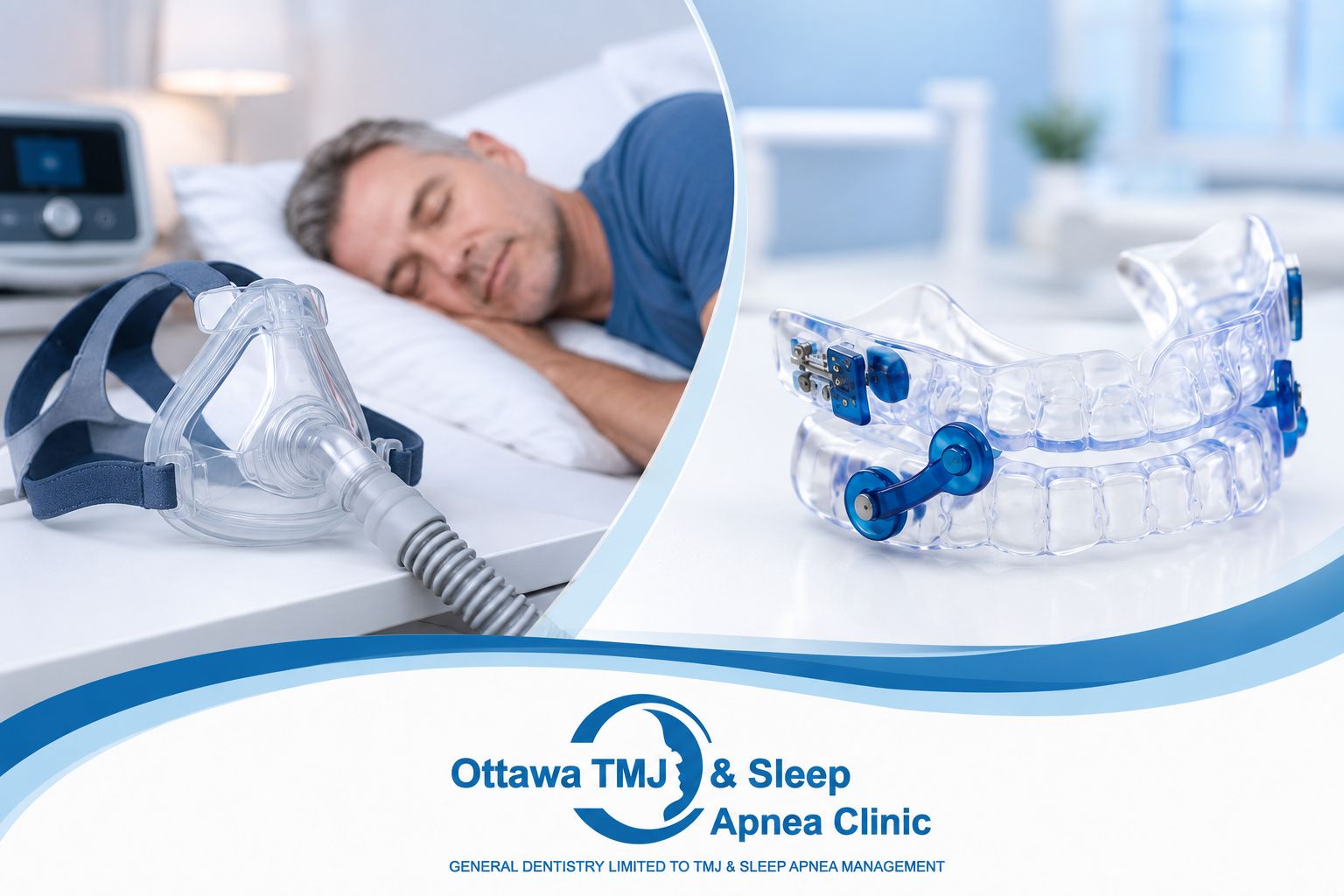
Getting told you have sleep apnea usually comes with one assumption: a mask, a hose, and a machine on the nightstand for good. For a meaningful share of patients, that assumption turns out to be incomplete.
Continuous positive airway pressure is the most studied treatment for obstructive sleep apnea (OSA), and when it’s worn consistently, it works well. Consistency is the hard part.
Research on CPAP use shows that close to half of patients stop within the first year, usually over comfort rather than results. An oral appliance is the alternative recognized by the American Academy of Sleep Medicine and the Canadian Thoracic Society.
This guide walks through how each treatment works, what changes in daily life, what each option costs over time, and which situations point toward one over the other. For a wider look at the full range of options, our guide to CPAP alternatives covers positional therapy and surgical options too.
Quick Answer
CPAP and oral appliance therapy are the two treatments recognized by sleep medicine guidelines for obstructive sleep apnea. CPAP controls more severe cases more predictably. A large share of patients stop using it within the first year anyway. Oral appliances are smaller, quieter, and generally easier to wear consistently, and they’re the recommended starting point for mild to moderate cases. The right choice depends on your AHI score, anatomy, and how consistently you’re likely to wear the device.
CPAP vs Oral Appliance: How Each Sleep Apnea Treatment Works
Both treatments target the same problem from different directions. CPAP keeps the airway open with pressure. An oral appliance keeps it open by repositioning the jaw. The mechanism behind each one shapes almost everything else in this comparison, from comfort to portability to cost.
How a CPAP Machine Works
A CPAP machine pushes a steady stream of pressurized air through a hose into a mask worn over the nose, mouth, or both. That air pressure keeps the throat from collapsing during sleep, which is what causes an apnea event in the first place.
The pressure setting is calibrated to the individual based on diagnostic testing, and some newer machines adjust pressure automatically through the night. Worn consistently, CPAP is capable of controlling breathing interruptions at almost any severity level.
How an Oral Appliance for Sleep Apnea Works
An oral appliance fits over the upper and lower teeth. Most designs used in dental sleep medicine, including devices like the Panthera D-SAD, SomnoDent, and the Thornton Adjustable Positioner, hold the lower jaw in a slightly forward position through the night.
That forward position pulls the tongue and surrounding soft tissue away from the back of the throat, opening space for air to move through. The device is custom fabricated from a digital scan of the teeth using the digital impression technology, then adjusted in small increments over a series of follow-up visits. You can see the specific oral sleep apnea appliances used at Ottawa TMJ and Sleep Apnea clinic in more detail.
Oral Appliance vs CPAP: Comfort and Daily Life With Each Option
Day-to-day experience is where most patients end up making their decision, regardless of what the research says about effectiveness. A CPAP setup includes a mask strapped to the face, a hose connecting to a machine, and in most cases a humidifier chamber that needs refilling. Some people adjust within a few weeks.
Others find the mask claustrophobic, the noise disruptive to a bed partner, or the setup difficult to manage while travelling, since it needs a power source.
An oral appliance fits in a shirt pocket case, makes no sound, and needs no electricity. The tradeoff appears in the first weeks of wear, when jaw soreness, extra saliva, or minor bite changes are common as the muscles and joint adjust. These effects usually settle with time and appliance adjustments, and knowing about them ahead of time makes that stretch easier to plan for.
Effectiveness for Mild, Moderate, and Severe Sleep Apnea
Severity, measured by the apnea-hypopnea index (AHI), plays a large role in which treatment guidelines recommend first. The AASM positions oral appliances as a first-line option for mild to moderate OSA, and as an alternative for severe OSA patients who cannot tolerate CPAP.
If you haven’t had a formal evaluation yet, this overview of sleep apnea risk factors is a starting point.
Clinical research backs this up with numbers. Among patients using a mandibular advancement device, roughly 70 percent see their AHI drop by more than half, and about a third experience complete resolution of their OSA.
CPAP, worn consistently, produces more uniform control across the full range of severity, which is why sleep physicians generally recommend trying it first for moderate to severe cases.
CPAP Therapy vs Oral Appliance Therapy: Comparing the Cost Over Time
The sticker price of treatment tells an incomplete story. A CPAP machine has a lower upfront cost in most cases. It also comes with an ongoing list of consumables such as CPAP mask cushions, filters, tubing, and humidifier water chambers, each on its own replacement schedule. Those costs accumulate for as long as the machine is in use.
An oral appliance has a higher upfront cost because it’s custom fabricated by a dental lab and requires clinical time to fit and adjust. After that, maintenance is simple, as it only requires regular cleaning, periodic check-ins, and an occasional adjustment or remake as the appliance wears over the years.
Comparing CPAP and oral appliance therapy across the factors
| Factor | CPAP | Oral Appliance |
|---|---|---|
| Best suited for | Moderate to severe OSA. | Mild to moderate obstructive sleep apnea, or severe OSA with CPAP intolerance. |
| Portability | Requires power source, bulkier for travel. | Fits in a small case, no power needed. |
| Noise | Machine hum, mask air leaks possible. | Silent. |
| Adjustment period | Mask fit, pressure tolerance. | Jaw soreness, saliva changes, early on. |
| Ongoing costs | Recurring supply replacement. | Periodic check-ins and occasional remakes. |
| Long-term monitoring | Machine usage data, physician follow-up. | Dental follow-up, occasional repeat testing. |
Can You Use CPAP and an Oral Device Together?
For patients whose OSA isn’t fully controlled by an appliance, combining the two is an option to raise with a care team. A 2020 study in the Journal of Applied Physiology found that pairing a lower-pressure CPAP setting with an oral appliance controlled OSA at pressures around 4 to 5 cmH2O, versus roughly 8 cmH2O with CPAP on its own. Lower pressure often means a quieter machine and a more comfortable mask seal.
This isn’t something to try without guidance. It takes coordination between a sleep physician and a dentist trained in dental sleep medicine, plus a follow-up sleep test to confirm the combination is working. It’s a middle path that doesn’t come up in conversation often enough.
Matching Treatment for Sleep Apnea to Your Lifestyle
Guidelines and averages point in a general direction. Daily routines determine if a treatment gets worn consistently. Two situations come up often enough in consultations to walk through directly.
CPAP vs Oral Appliance for People Who Travel Often
Frequent flyers often find an oral appliance easier to work into a routine. It needs no outlet, no batteries, and no explanation at airport security beyond what any small dental device would require. CPAP is permitted as carry-on medical equipment on most airlines, but packing the unit and hose, then finding a plug in an unfamiliar hotel room, adds friction a device the size of a mouthguard doesn’t create.
CPAP vs Oral Appliance for Severe Sleep Apnea
A high AHI score generally keeps CPAP as the first recommendation, since it offers the most consistent control at that severity. An oral appliance remains an option for people who’ve tried CPAP and cannot tolerate it, sometimes paired with the combination approach above and confirmed with a follow-up sleep test.
Not Sure Which Sleep Apnea Treatment Option Fits Your Situation?
Dr. Dahan and the team at Ottawa TMJ & Sleep Apnea Clinic can review your history and diagnostic results together and walk through what each treatment would look like for you.
Frequently Asked Questions
Can I switch from CPAP to an oral appliance?
Talk with your prescribing physician and your dentist before making the change. Stopping CPAP on your own isn’t recommended, particularly if your OSA is moderate to severe. Once an oral appliance is fitted, a follow-up test confirms it’s controlling your sleep apnea to the standard your care team expects.
Does insurance cover oral appliance therapy in Canada?
OHIP doesn’t cover TMJ or sleep apnea treatment fees at this clinic. Many extended health and dental insurance plans reimburse a portion of oral appliance therapy, and our team can provide documentation to submit to your provider.
Is an oral appliance as effective as CPAP for severe sleep apnea?
For severe cases, CPAP generally produces more predictable, complete control of breathing interruptions. An oral appliance can still meaningfully reduce symptoms for many patients who cannot tolerate CPAP, particularly when paired with follow-up testing or the combination approach described earlier in this guide.
What else can help alongside CPAP or an oral appliance?
Weight management, side sleeping, and reducing alcohol before bed all support either treatment. Our guide on helping prevent obstructive sleep apnea walks through these steps in more detail.