
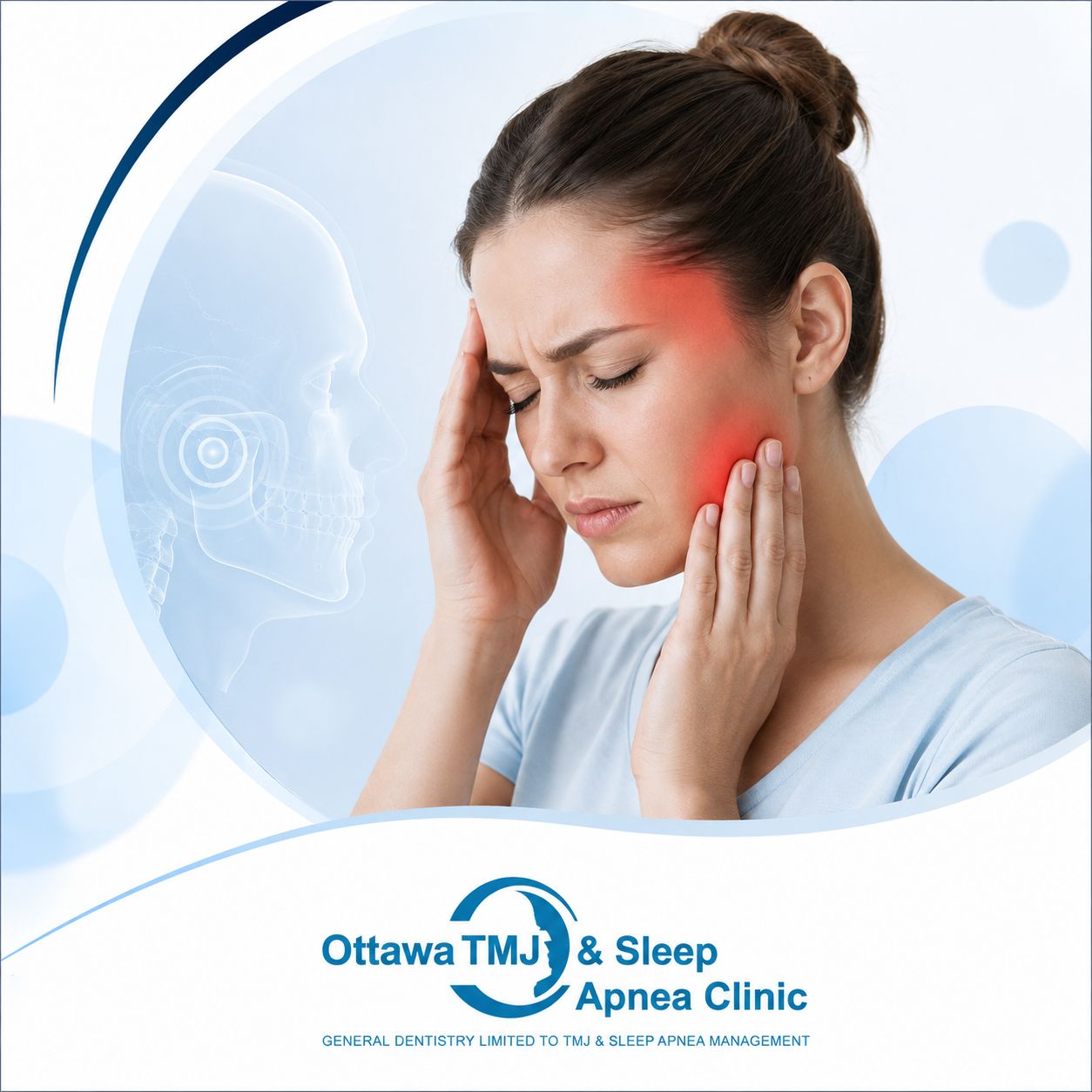
Waking up with a pounding headache that seems to start in your jaw is disorienting. You take something for the pain, wait it out, and find yourself back in the same place a week or two later. For many people, this cycle repeats for months before anyone raises a possible jaw connection.
A 2022 meta-analysis in Cephalalgia Reports found that approximately 62% of people with temporomandibular disorder (TMD) experience recurrent headaches. Migraines are present in around 40% of that group. For a significant portion of those patients, addressing what’s happening in the jaw is what shifts the headache pattern.
This post covers what a TMJ migraine is, the symptoms that point to jaw involvement, what drives it, and the approaches available at Ottawa TMJ & Sleep Apnea Clinic.
What Is a TMJ Migraine?
The temporomandibular joint sits in front of each ear, where the lower jaw connects to the skull. You use it when you chew, speak, yawn, or swallow. Supporting it is a network of muscles, ligaments, and a small disc of cartilage that keeps movement smooth and controlled.
When this system is under strain from muscle overuse, joint inflammation, alignment problems, or disc displacement, pain frequently extends beyond the jaw itself.
The trigeminal nerve, which carries sensation from the face, jaw, temples, and forehead to the brain, runs through this region. Chronically overworked or inflamed jaw muscles can irritate the trigeminal nerve and activate the same pain pathways associated with migraine-type head pain.
A TMJ migraine refers to a migraine episode triggered or worsened by dysfunction in the temporomandibular joint or its surrounding musculature. The term describes how temporomandibular disorder (TMD) acts as a migraine trigger in a given patient.
For a clear breakdown of the distinction between the joint (TMJ) and the disorder (TMD), our guide to TMD vs. TMJ covers the differences in depth.
What are TMJ Migraine Headache Symptoms?
Jaw-related headaches share features with tension headaches, sinus headaches, and cluster headaches, which is part of why the connection to the jaw takes so long to identify.
Some patterns that tend to point toward TMJ involvement.
- Head pain at the temples, behind the eyes, or along one side of the head.
- Jaw soreness or stiffness that precedes or accompanies a headache.
- Clicking or popping in the jaw when opening or closing the mouth.
- Ear pain or a sense of fullness in one or both ears without infection.
- Neck tension or stiffness, particularly upon waking.
- Tooth sensitivity or achiness without a clear dental cause.
- Headaches that worsen during periods of jaw tension or prolonged jaw use.
That last pattern is often the clearest signal. When a headache consistently intensifies with jaw activity, or when pressing on the jaw muscles reproduces the pain, there is a clinical reason to investigate the joint.
For a broader look at what symptoms may indicate TMD, this TMD symptom overview is a useful starting point. You may also find What You Didn’t Know About Migraines useful for context on the migraine side of the picture.
What Triggers a TMJ Migraine?
Several factors put consistent stress on the temporomandibular joint and surrounding muscles. The underlying trigger matters because the same headache pattern can arise from different root causes, and treatment follows accordingly.
Teeth grinding and clenching (bruxism)
Bruxism is among the most common contributors to jaw-related headaches. Grinding or clenching during sleep generates significant muscular force, and most people are unaware it is happening. Over time, the jaw muscles fatigue and become sensitized, creating conditions for recurring head pain. The connection between sleep bruxism and morning headaches is well established, and the two frequently present together.
Jaw misalignment and bite problems
When the upper and lower teeth don’t meet evenly, the jaw muscles compensate with each bite. That ongoing muscular effort builds tension across the temporal region and can set off head pain over time. Bite imbalance is a structural cause that typically requires an in-person assessment to identify.
Chronic stress and muscle guarding
High psychological stress leads many people to clench their jaw, frequently without realizing it. The masseter and temporalis muscles hold tension long after a stressor has passed. Persistent guarding in these muscles creates a direct pathway to headache.
Arthritis in the joint
Both osteoarthritis and rheumatoid arthritis can affect the TMJ directly. As joint surfaces deteriorate or inflame, pain signals travel through the same nerve pathways that contribute to head pain. TMJ arthritis is more common than many people realize and can be an underlying factor in cases where headaches don’t respond to other approaches.
History of jaw or neck injury
A past injury to the jaw, face, or cervical spine can alter how the joint tracks during movement. Compensatory patterns often develop gradually, and headache symptoms may surface long after the original injury.
Who Is Most Likely to Experience a TMJ Migraine?
Women between the ages of 20 and 40 are disproportionately affected by both TMJ disorders and migraines. TMD is significantly more prevalent in women, and research points to hormonal fluctuations as a contributing factor in both conditions. The National Headache Foundation has documented this clinical overlap.
People who grind or clench are at elevated risk, as are those with a history of jaw or neck trauma. High-stress occupations and disrupted sleep also appear consistently across patient profiles.
The relationship between the two conditions is bidirectional. A 2024 review published in the British Dental Journal found that patients with painful TMD are significantly more likely to have migraines, and people with migraines are significantly more likely to develop TMD. Treating one condition can reduce the burden of the other, though the appropriate path depends on individual assessment.
TMJ Migraine Relief Options
Custom oral appliances
A dental appliance worn during sleep repositions the jaw to reduce muscle strain and protect the joint from grinding forces. Ottawa TMJ & Sleep Apnea Clinic uses custom appliances as part of its headache management approach. Read more about the TMJ therapy offered at the clinic.
Therapeutic jaw exercises
Targeted exercises restore range of motion, reduce muscle guarding, and improve how the joint moves during daily activities. These are introduced progressively as part of an ongoing care plan rather than as a standalone intervention.
Lifestyle adjustments
A soft food diet during flare-ups, stress management practices, improved sleep posture, and reducing habits like gum chewing or jaw-clenching during concentration can lower headache and migraine frequency meaningfully over time.
Muscle relaxant injections
For migraine sufferers with significant jaw muscle tension, botulinum toxin injections offer an additional avenue. Administered into the masseter, temporalis, and related muscles, they temporarily reduce the force of involuntary contractions, lowering the mechanical load on the joint and surrounding tissue.
Book an Assessment Today
Infrequent jaw soreness or the occasional tension headache after a stressful period is common. The pattern that warrants a closer look is more persistent:
- Headaches occur several times per month.
- Jaw pain or stiffness is present on most mornings.
- A known or suspected history of teeth grinding.
- Headaches that consistently worsen during high-stress periods or after sleeping.
- TMJ pain relief that addresses individual episodes but doesn’t reduce how frequently they occur.
An assessment with Dr. Dahan involves examination of the jaw joint and surrounding muscles, a thorough symptom review, and imaging where appropriate.