
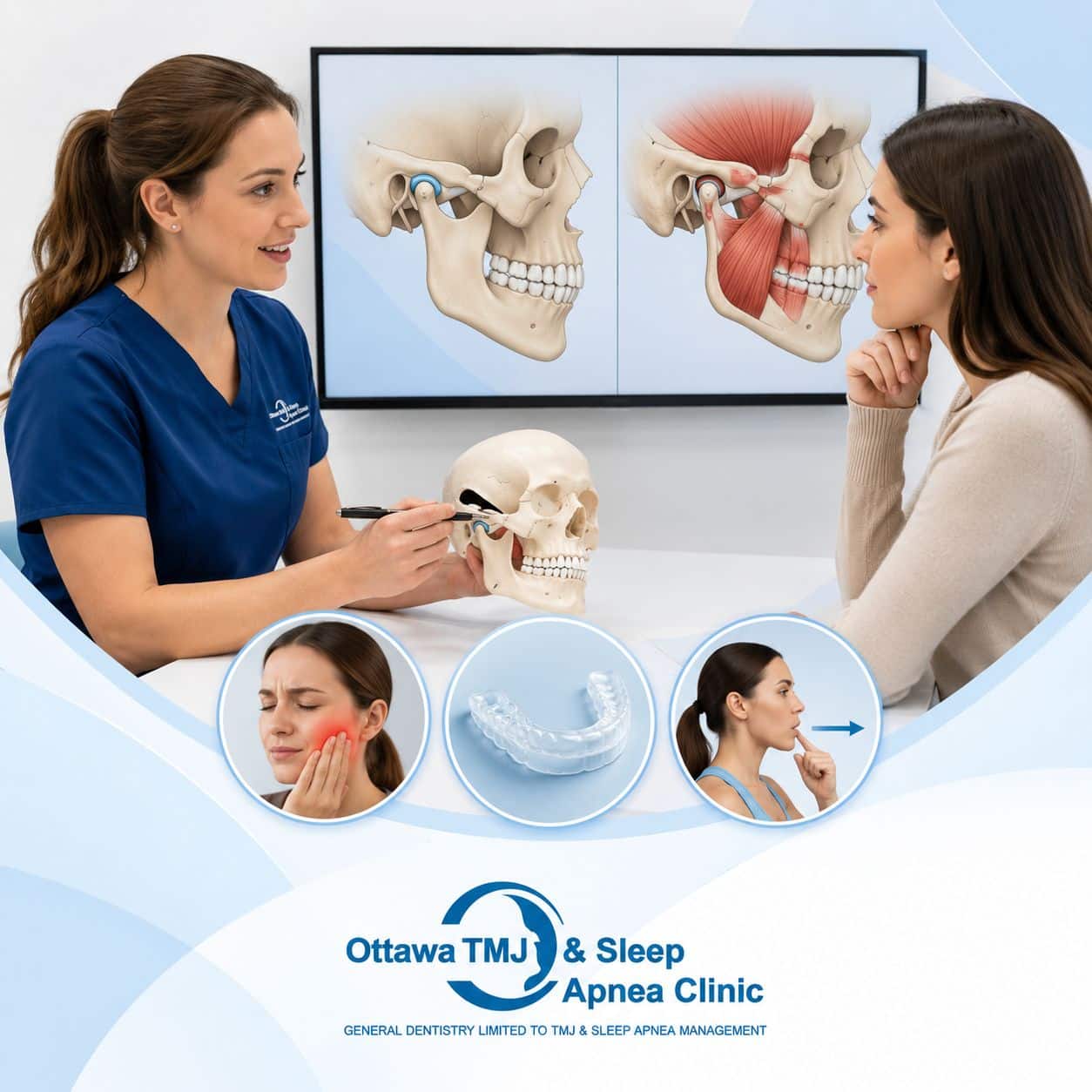
This article aims to clarify these terms, explore the symptoms and causes of TMD, and provide an overview of treatment options available. Whether you’re searching for answers to “what is TMJ” or “what is TMD,” we’ve got you covered.
TMD vs TMJ: Understanding The Difference
TMJ (temporomandibular joint) is a part of your anatomy. It’s the joint that connects your lower jaw to your skull. TMD (temporomandibular disorder) is a medical condition that occurs when something goes wrong with the joint or the surrounding muscles. Everyone has a TMJ; not everyone has TMD.
| Feature | TMJ | TMD |
|---|---|---|
| Full name | Temporomandibular Joint | Temporomandibular Disorder |
| What it refers to | The jaw joint (anatomy) | The condition/disorder |
| Who has it? | Everyone. It’s a body part | Affects ~1 in 6 Canadians |
| Is it a diagnosis? | No | Yes |
| Requires treatment? | No, unless affected by TMD | Yes, when symptomatic |
| Associated symptoms | None on its own | Pain, clicking, limited movement |
What is TMJ (Temporomandibular Joint)?
Definition and Function of TMJ
The term TMJ stands for temporomandibular joint. This critical joint connects your jawbone to your skull, allowing you to perform essential functions such as chewing, speaking, and yawning. Located on either side of your head, just in front of your ears, the TMJ is one of the most complex joints in the body due to its ability to move both up and down and side to side.
You actually have two TMJs, one on each side of your face. You can locate them by placing your fingertips just in front of your ear canals and opening your mouth slowly. The movement you feel is your TMJs at work.
Anatomy of the Temporomandibular Joint
The temporomandibular joint is a hinge-like structure composed of several key components, including bones, muscles, and ligaments. The main parts include:
- Mandibular condyle: A rounded end of the jawbone (mandible) that fits into the joint.
- Articular disc: It is a small cushioning pad that absorbs shock and keeps movements smooth.
- Glenoid fossa: The socket in the temporal bone that the condyle rests in.
- Masticatory muscles: The powerful muscles (including the masseter and temporalis) that move the jaw.
- Ligaments and synovial fluid: Stabilizing structures that lubricate and protect the joint.
These components work together to facilitate smooth jaw movements. When any one of them is damaged, inflamed, or misaligned, the result can be TMD.
What is TMD (Temporomandibular Disorder)?
Definition and Causes of TMD
TMD, or temporomandibular disorder, refers to a group of conditions that affect the temporomandibular joint and the muscles controlling jaw movement. It’s important to note that TMD is actually an umbrella term that covers more than 30 distinct conditions affecting the jaw joint, masticatory muscles, and associated structures.
These disorders can arise from various causes.
- Injury to the jaw, head, or neck (such as whiplash)
- Bruxism (teeth grinding or clenching). One of the most common contributors
- Arthritis (osteoarthritis or rheumatoid arthritis) affecting the joint
- Disc displacement or internal derangement of the TMJ
- Stress and psychological factors, which increase muscle tension
- Genetic predisposition and hormonal influences
- Dental occlusion problems (misaligned bite)
Research from the NIDCR confirms that in many cases, no single cause can be pinpointed. TMD may result from a combination of genetic, psychological, and biomechanical factors.
Types of TMD
TMD can be categorized into three main types.
- Myofascial Pain. The most common type. Involves discomfort or experiencing pain in the jaw muscles that control jaw function, often spreading to the face, neck, and shoulders. Bruxism is a frequent driver of this type.
- Internal Derangement. It refers to a misalignment or displacement of the articular disc or a dislocated jaw. This is often what produces the characteristic clicking or popping sounds.
- Arthritis. It includes degenerative or inflammatory joint disorders (such as osteoarthritis or rheumatoid arthritis) affecting the TMJ, causing progressive damage to the cartilage and bone.
It’s also possible to have a combination of all three types simultaneously. Understanding the type of TMD you have is essential for determining the most effective treatment plan.
Key Differences Between TMJ and TMD
Terminology Differences
The primary distinction is the terminology. TMJ refers to the joint itself, while TMD refers to the disorders affecting this joint. Confusion often arises because people use TMJ to describe the disorder, but technically, TMJ is a part of your anatomy, whereas TMD refers to the condition.
You may also encounter the term TMJD (temporomandibular joint disorder). This is simply another term for TMD, and the two are used interchangeably in clinical settings.
Functional Differences Between TMD and TMJ
Functionally, the TMJ allows for the movement and function of the jaw. In contrast, TMD involves dysfunction of this joint, leading to symptoms such as pain, limited movement, and clicking sounds. Recognizing this difference is crucial for accurate diagnosis and treatment.
Who is at Risk for TMD?
TMD is far more common than most people realize. According to the University of Toronto’s Faculty of Dentistry, TMD affects approximately 1 in 6 Canadians. This makes TMD the most common cause of non-dental orofacial pain and the second most frequent painful musculoskeletal disorder after chronic low back pain.
Key risk factors of TMD
- Sex: Women are twice as likely to develop TMD compared to men, and tend to experience more severe symptoms. Researchers are investigating the role of female sex hormones in TMJ structure and pain sensitivity.
- Age: TMD is reported to occur most commonly between the ages of 20 and 40.
- Stress and anxiety: Psychological stress directly increases muscle tension in the jaw.
- Bruxism (teeth grinding or clenching): A major modifiable risk factor, often occurring during sleep.
- Previous jaw or head injury: This includes sports injuries and motor vehicle accidents (whiplash).
- Comorbid conditions: TMD frequently co-occurs with conditions such as chronic headaches, fibromyalgia, sleep apnea, and irritable bowel syndrome.
If any of these risk factors apply to you and you’re experiencing jaw discomfort, seek an early assessment at the Ottawa TMJ clinic.
Symptoms of TMD
Common TMD Symptoms
TMD can manifest through a variety of symptoms, including:
- Jaw pain and discomfort or tenderness
- Headaches or migraines
- Clicking, popping, or grating sounds when opening or closing the mouth
- Difficulty chewing or biting
- Ear pain or ringing in the ears (tinnitus)
- Locking of the jaw joint, making it difficult to open or close the mouth
- Facial pain or swelling
- Neck, shoulder, or upper back pain
- Limited range of jaw motion
An important distinction! Clicking or popping sounds without pain are relatively common in the general population and are not always a sign of TMD. Pain is the defining feature. If joint sounds are accompanied by discomfort or movement restriction, that warrants an evaluation from an Ontario dentist with training in TMJ in Ottawa.
When to Seek Help for TMD
If you experience persistent jaw pain, frequent headaches, or any of the symptoms listed above, it’s essential to seek professional help. Early intervention can prevent the condition from worsening and improve your quality of life. At the Ottawa TMJ & Sleep Apnea Clinic, no doctor’s referral is needed and you can contact us directly to begin your assessment.
The TMD-Bruxism-Sleep Apnea Connection
One area that is often overlooked is how closely TMD, bruxism, and obstructive sleep apnea are interconnected. Many patients who present with jaw pain are also found to be grinding their teeth at night (sleep bruxism), and a significant proportion also have undiagnosed sleep apnea.
- Sleep apnea causes repeated airway obstruction. It triggers the jaw and tongue muscles to compensate, which increases clenching and grinding.
- Bruxism creates excessive compressive forces on the TMJ and masticatory muscles, accelerating disc displacement and myofascial pain.
- TMD pain can in turn disrupt sleep quality, worsening sleep apnea outcomes.
This is why a comprehensive TMD treatment approach must evaluate all three conditions together. At the Ottawa TMJ & Sleep Apnea Clinic, Dr. Dahan focuses on this integrated assessment.
Diagnosis of TMD
Diagnostic Procedures for TMD
Diagnosing TMD typically involves a combination of physical exams and imaging tests. Your healthcare provider may:
- Examine your jaw for tenderness, clicking, or locking.
- Observe the range of motion in your jaw.
- Take X-rays, CT scans, or MRI scans to get a detailed view of the joint and surrounding tissues.
Role of Healthcare Professionals in Diagnosis and Treatment of TMD
Dentists and Ontario dentist with training in TMJ play a vital role in diagnosing and treating TMD. They can develop a personalized diagnosis and treatment plan based on the severity and type of your disorder, helping you manage symptoms effectively and improve joint function.
For complex or chronic cases where TMD co-exists with sleep apnea or chronic headaches, a practitioner with focused training, like Dr. Dahan (a Qualified Ontario dentist with training in TMJ with the American Academy of Dental Sleep Medicine), is the most appropriate provider.
Treatment Options for TMD
The good news is that the majority of TMD cases (75–90%) respond well to conservative, non-surgical treatment. Surgery is rarely necessary, and irreversible treatments are generally not recommended as first-line options.
Non-Surgical Treatments for TMD
- Medications: Pain relievers (NSAIDs like ibuprofen or naproxen), muscle relaxants, and in some cases, low-dose tricyclic antidepressants or anticonvulsants for chronic pain management.
- Physical Therapy: Exercises and techniques designed to strengthen and stretch the jaw muscles, improve posture, and reduce pain through manual therapy and therapeutic modalities.
- Dental Appliances (Oral Splints): Custom-fitted bite guards or occlusal splints to prevent bruxism, reduce joint loading, and correct jaw alignment.
- Stress Management: Techniques such as relaxation exercises, counseling, or cognitive behavioral therapy to manage stress and reduce muscle tension.
- Botox Injections: Targeted botulinum toxin injections into the masticatory muscles (masseter, temporalis) to reduce muscle hyperactivity and pain.
Self-Care Tips for TMD
In addition to personalized treatments, self-care practices can help manage TMD symptoms:
- Jaw Exercises: Gentle stretching and strengthening exercises recommended by your healthcare provider.
- Heat and Cold Therapy: Applying heat or cold packs to the jaw to reduce pain and swelling.
- Dietary Changes: Eating soft foods and avoiding hard, chewy, or sticky foods.
- Good Posture: Maintaining good posture to reduce strain on the jaw.
Get TMD Assessment in Ottawa
If you experience symptoms of TMD, such as jaw pain, headaches, or clicking sounds, don’t wait for them to worsen. The Ottawa TMJ & Sleep Apnea Clinic focuses exclusively on TMJ disorders, sleep apnea, and chronic facial pain that require in-depth knowledge and an evidence-based approach.
Dr. Haissam Dahan is an experienced Ontario dentist with training in TMJ who has taught at Harvard, Tufts, and McGill Universities and holds qualifications with the American Academy of Dental Sleep Medicine. Our team provides comprehensive, personalized care with no doctor’s referral required. Contact us today or call us directly at (613) 454-1854.
Frequently Asked Questions About TMJ vs TMD
Is TMJ the same as TMD?
No. TMJ stands for temporomandibular joint, which is a part of your anatomy. TMD stands for temporomandibular disorder, which is a medical condition affecting that joint. Everyone has a TMJ, but not everyone has TMD.
What does TMD feel like?
TMD typically causes jaw pain or tenderness, headaches, clicking or popping in the jaw, difficulty chewing, and sometimes ear pain or a blocked feeling in the ears. Pain is often worse in the morning if you grind your teeth at night.
Can TMD go away on its own?
In some cases, yes, particularly for mild or acute TMD. Research suggests that up to 40% of patients experience some remission without treatment. However, chronic or severe cases require professional intervention. Ignoring symptoms can lead to progressive joint damage.
Is TMD covered by OHIP or insurance in Ontario?
OHIP does not cover TMD treatments at the Ottawa TMJ & Sleep Apnea Clinic. However, some dental and medical insurance plans may cover a portion of treatment costs. We recommend contacting your insurer directly, and our team can provide the documentation you need for claims.
What is an effective treatment for TMD in Ottawa?
The most effective approach is a personalized, conservative treatment plan that may include an oral splint, physiotherapy, stress management, and, if appropriate, Botox for muscle-related pain. At the Ottawa TMJ & Sleep Apnea Clinic, Dr. Dahan creates individualized treatment plans based on each patient’s specific type and severity of TMD.
Can TMD cause ear pain?
Yes. Because the TMJ sits directly in front of the ear canal, inflammation or dysfunction in the joint frequently causes ear pain, a sensation of fullness, or tinnitus (ringing in the ears). Many TMD patients are initially investigated for ear conditions before TMD is identified as the cause.
How is TMD diagnosed?
TMD is diagnosed through a clinical examination of the jaw, assessment of range of motion, palpation of masticatory muscles, and imaging (X-ray, CT, or MRI). Specialists may also use the validated Diagnostic Criteria for Temporomandibular Disorders (DC/TMD) protocol for precise classification.
Note: Medically reviewed and written by Dr. Haissam Dahan, DDS. Experienced in TMJ Disorders & Dental Sleep Medicine, Ottawa TMJ & Sleep Apnea Clinic. Faculty instructor at Harvard, Tufts, and McGill Universities.