Your partner tells you that you snore. You wake up tired despite a full night in bed. Your jaw aches in the morning and your head feels heavy before the day has started. These feel like three unrelated problems, but for many people, they share a common thread. Understanding the difference between snoring and obstructive sleep apnea (OSA) matters for your sleep, your cardiovascular health, and in ways most patients never hear about, your jaw.
What’s Happening When You Snore
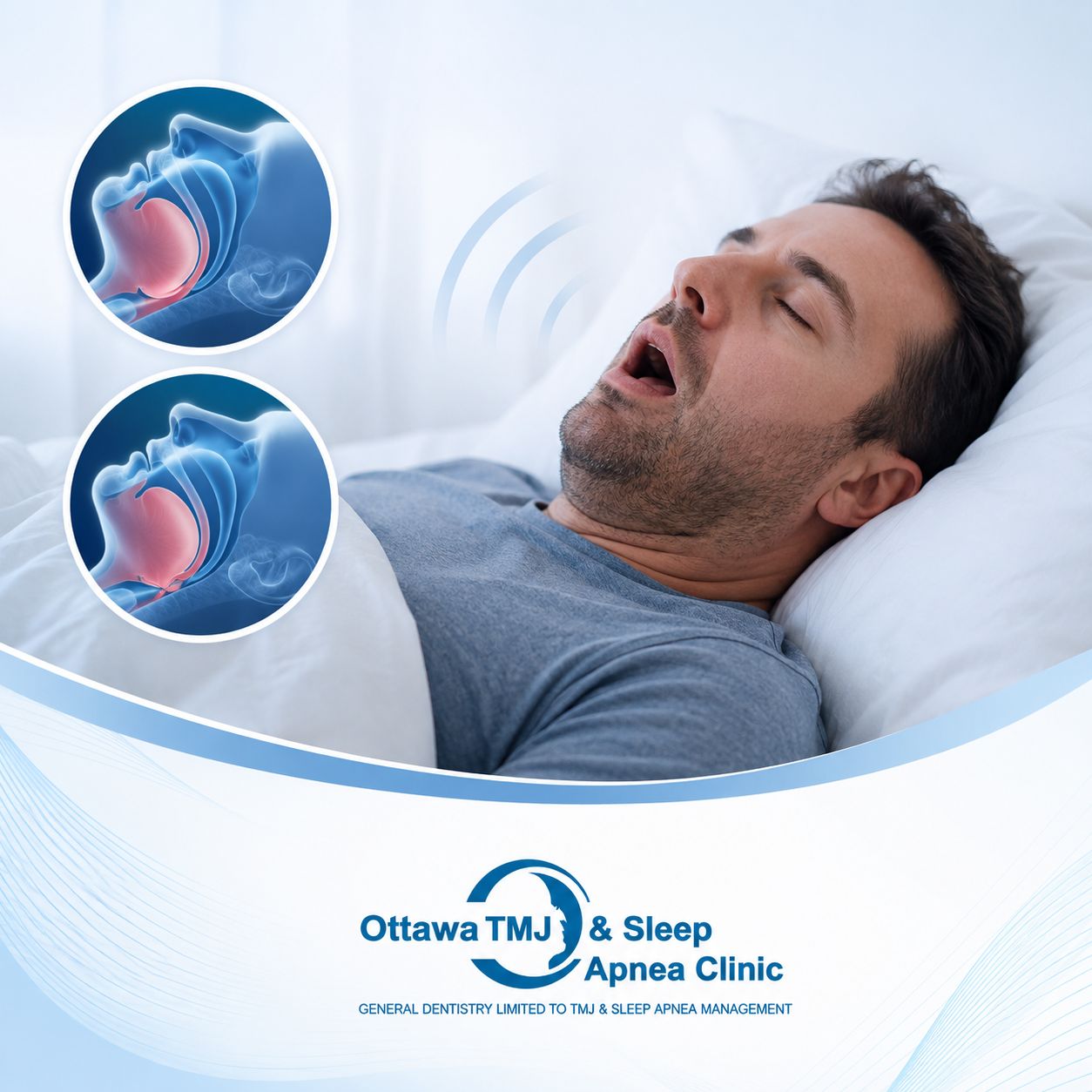
Snoring is a sound. At its most basic, it’s what happens when air moves through a throat that has narrowed during sleep. The tongue, soft palate, and uvula are the soft tissues at the back of the throat, and they relax and vibrate as airflow passes through, producing that familiar rumbling sound.
According to Harvard Health Publishing, roughly 40 to 50 percent of adults snore at least occasionally. A cold, alcohol before bed, sleeping on the back, or nasal congestion can all set it off. Occasional snoring tied to a temporary cause is generally not a health concern, even if it’s inconvenient for the person sharing your room.
Throughout all of this, airflow continues. Snoring narrows the passage but does not close it. That distinction between a narrowed airway and a completely blocked one is what separates snoring from sleep apnea, and the health implications on either side of that line are significantly different.
Snoring vs Sleep Apnea: What Makes Obstructive Sleep Apnea Different
With obstructive sleep apnea, the airway does not simply narrow; it collapses. The soft tissues at the back of the throat relax to the point of fully blocking airflow. Breathing stops, sometimes for ten seconds, sometimes considerably longer, sometimes many times per hour. The brain detects the falling oxygen level and triggers a brief arousal to restart breathing, often accompanied by a gasp, a snort, or a choking sound.
80–90% of people with moderate-to-severe OSA are estimated to be undiagnosed, according to research published in the Journal of Clinical Sleep Medicine. That gap exists partly because snoring is easy to attribute to lifestyle and dismiss.
This cycle can repeat dozens or hundreds of times through a single night. The person experiencing it frequently has no memory of waking up. But the physiological cost accumulates: fragmented sleep, repeatedly lowered oxygen levels, elevated stress hormones, and sustained strain on the cardiovascular system.
Clinicians measure OSA severity using the apnea-hypopnea index (AHI), which counts how many times per hour breathing stops or significantly decreases. Mild OSA starts at five events per hour. Severe OSA exceeds thirty. Neither level should be left unaddressed.
The Key Difference Between Snoring and Sleep Apnea
Snoring alone does not confirm sleep apnea. But snoring combined with certain other patterns is worth bringing to a professional. Below is a comparison of the two conditions at a glance, followed by the specific signs that point toward OSA rather than simple snoring.
| Factor | Snoring | Obstructive Sleep Apnea |
|---|---|---|
| Airway during sleep | Narrowed. Air still moves. | Fully collapses, repeatedly. |
| Breathing pauses | No | Yes, 10 seconds or longer per episode. |
| Oxygen levels | Unaffected | Drop repeatedly through the night. |
| Daytime fatigue | Uncommon | Very common, often significant. |
| Morning symptoms | Rare | Headaches, dry mouth, jaw pain. |
| Cardiovascular risk | Minimal when isolated | Linked to hypertension, heart disease, stroke. |
| What a partner observes | Sustained noise | Noise, then silence, then gasping. |
Signs a professional assessment makes sense
- Snoring that stops abruptly, then restarts with a gasp or choking sound.
- Morning headaches that appear regularly.
- Feeling unrefreshed after a full night of sleep.
- Persistent daytime fatigue or difficulty staying focused.
- Jaw pain, tooth sensitivity, or facial tightness upon waking.
- Frequently waking with a dry mouth or sore throat.
- A bed partner who has noticed pauses in your breathing.
How Sleep-Disordered Breathing During Sleep Connects to TMJ Pain Relief
The jaw and the airway are not separate systems, and this is the piece of the picture that most patients never hear. The position of the lower jaw during sleep directly influences how much space exists at the back of the throat. When the jaw rests too far back, the tongue follows, and the available airway narrows. For people with temporomandibular disorder (TMD), jaw position during sleep can be unstable, compounding both airway restriction and joint strain.
TMD affects the temporomandibular joint, the hinge connecting the lower jaw to the skull. This joint controls jaw movement for chewing, speaking, and swallowing. When it comes under persistent stress through muscle tension, misalignment, or nighttime grinding, the surrounding muscles tighten and the jaw loses its resting stability. If you have been noticing jaw pain, clicking, or facial pressure and are unsure of the cause, this post on recognizing TMD symptoms walks through the most common indicators.
How Airway Obstruction Puts Strain on the Jaw
When the airway is partially or fully blocked during sleep, the body activates a protective reflex. Muscles in the jaw, tongue, and throat tense in an effort to restore airflow. In many people, this reflex manifests as grinding or clenching the teeth — a condition called sleep bruxism.
Research has consistently found elevated rates of sleep bruxism among people with sleep apnea compared to the general population. The repeated muscle activation throughout the night places significant strain on the TMJ and the muscles surrounding it. Patients often describe waking with jaw soreness, tight facial muscles, or the sensation that they have been clenching all night. Physiologically, that is close to what has been happening.
According to the TMJ Association, jaw pain from TMD tends to be cyclical, and it can be difficult to address when its contributing factors remain unexamined.
Why TMJ Pain Relief Starts With Addressing the Airway
Jaw-focused care alone may not produce lasting TMJ pain relief when nighttime airway obstruction is the underlying driver. The body continues to clench in response to pauses in breathing, and the joint continues to absorb that force. Treating the joint without evaluating what is causing the clenching addresses the downstream effect, not the source.
At Ottawa TMJ & Sleep Apnea Clinic, Dr. Haissam Dahan assesses both the jaw and the airway together rather than treating them as independent concerns. This evidence-based, non-surgical sleep apnea treatment allows care to reach the source of symptoms of sleep apnea. For a grounding in the distinctions between TMJ and TMD and what each involves clinically, that earlier post provides useful context before a first consultation.
Related blog: Sleep Apnea: Are You or Your Loved One at Increased Risk?
Seek a Professional Assessment
Snoring on its own is common, and for many people it stays noisy, but not a health concern requiring intervention. A professional assessment makes sense when snoring accompanies other signs: jaw pain that’s present every morning, headaches that do not resolve, fatigue that sleep does not fix, or a bed partner who has witnessed pauses in your breathing.
Both conditions are manageable through non-surgical, evidence-based approaches. Neither requires accepting chronic discomfort or fatigue as unavoidable. Speaking with a practitioner focused on jaw health and sleep-disordered breathing is a productive first step toward understanding what is driving your sleep apnea symptoms and what care might look like for your specific situation.
Dr. Dahan provides comprehensive assessments for jaw pain, loud snoring, and sleep-related breathing concerns at Ottawa TMJ & Sleep Apnea Clinic. Request a Consultation.