
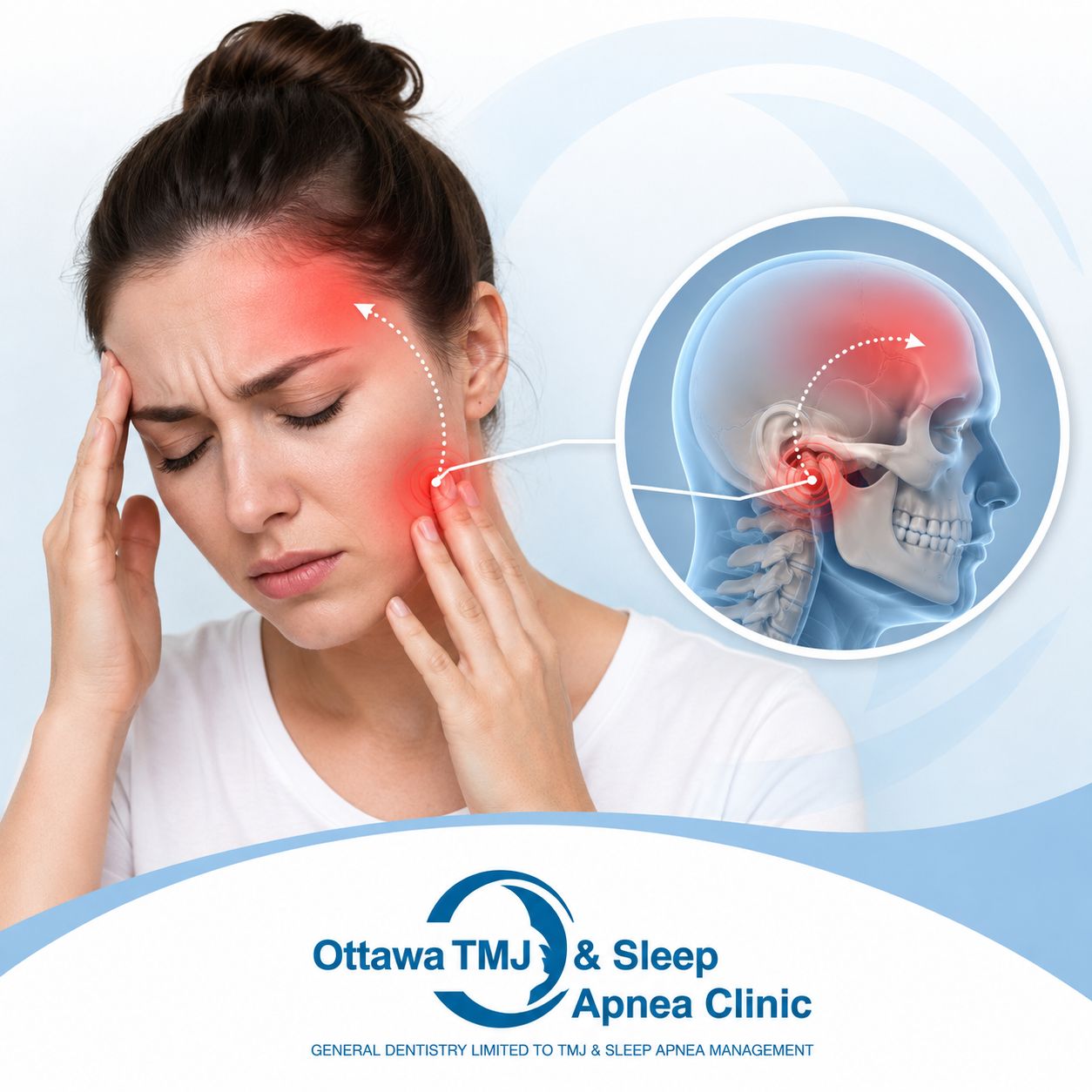
You take something for the headache. It dulls a little, then returns the next morning. You try again. Still there. This cycle is a familiar one for a large number of people who have spent a significant amount of time treating what seems like a stubborn tension headache or recurring migraine, without ever addressing the actual source of the pain.
The temporomandibular joint, or TMJ, connects your lower jaw to your skull just in front of each ear. When this joint or the muscles surrounding it are under sustained strain, the TMJ pain does not stay contained to the jaw. It travels. For many people, that referred pain lands in the temples, behind the eyes, across the forehead, or at the base of the skull.
So, can TMJ cause headaches? Yes. According to the National Institute of Dental and Craniofacial Research, temporomandibular disorders (TMD) affect an estimated 5 to 12 percent of adults, and TMJ-related headaches or migraines are among the most frequently reported TMJ symptoms.
How Can TMJ Cause Headaches?
The jaw contains some of the most powerful muscles in the body. The masseter and temporalis muscles, which handle chewing and jaw closure, attach directly to the temples and sides of your head. When these muscles are chronically overloaded from clenching, grinding, poor jaw positioning, or joint inflammation, they become a direct source of referred pain in the head.
There are three main pathways by which TMD triggers headache pain.
Muscle tension and trigger points
Sustained tension in the jaw muscles creates myofascial trigger points. The temporalis muscle alone, when inflamed, can produce a diffuse aching sensation across the forehead, scalp, and temples that is almost indistinguishable from a tension headache or migraines.
Trigeminal nerve involvement
The temporomandibular joint sits in close proximity to the trigeminal nerve, which is the largest cranial nerve and the primary carrier of sensory signals from the face and head. When the joint is irritated or inflamed, the disruption along this nerve pathway can produce headache pain that appears to have no obvious origin.
Cervical compensation
A strained or misaligned jaw often causes the neck and upper spine muscles to compensate. That postural shift generates tension throughout the base of the skull and upper cervical region, adding another layer of head pain that compounds the jaw-driven symptoms.
Understanding these pathways also helps explain why TMD symptoms can affect daily life in ways that go well beyond jaw discomfort.
Can TMJ Cause Headaches While You Sleep?
Morning headaches are one of the most telling signs that the pain is originating in the jaw.
During sleep, many people clench or grind their teeth with no awareness of doing so. This is known as sleep bruxism, and the forces involved are considerable. Nighttime jaw activity can generate pressure that significantly exceeds normal biting force.
The jaw muscles, having worked hard for hours in this way, are inflamed and tight by morning, and that muscular tension translates directly into head pain upon waking.
The pattern tends to follow a recognizable rhythm. The headache is present immediately upon waking, often concentrated at the temples or the back of the head. It may ease slightly as the day goes on, then return the following morning. Research reviewed by WebMD confirms that grinding and clenching during sleep are among the most common triggers for TMJ-related morning headaches, and that this timing pattern is a meaningful clinical indicator worth discussing with a practitioner.
Can Headaches Caused by TMJ Disorder Feel Like Migraines?
TMD-related headaches frequently mimic migraines. The features like throbbing quality, the unilateral onset, and in severe cases the sensitivity to light or sound can look identical to a classic migraine presentation.
The distinction lies in the trigger. A migraine driven by neurological factors often has prodrome symptoms such as visual aura, mood shifts, or light sensitivity in the hours before the pain begins. A headache driven by TMJ dysfunction typically follows periods of sustained jaw use, high-stress clenching, or a night of grinding.
For people whose migraines respond poorly to standard medications, TMD as a contributing factor is worth investigating. Clinical commentary from Baylor Scott & White Health notes that treating the underlying jaw condition can reduce both the frequency and intensity of migraine-like headaches in patients where TMD is a confirmed trigger.
Some patients with headaches and migraines arrive at the clinic having tried multiple migraine medications with limited results. After a thorough assessment of the jaw, muscles, and bite, a personalized treatment option produces the change they had been looking for. The mechanism is not mysterious once you understand that the trigeminal nerve is involved in both migraine and jaw pain pathways.
For a closer look at how TMD intersects with migraine pain specifically, this post covers what most people don’t know about migraines and their triggers.
Signs Your Headaches May Be Coming From Your Jaw
Before seeking a formal assessment, these patterns can help you determine whether a jaw connection is worth discussing with a practitioner.
- Headaches that are worst in the morning or worsen after eating.
- Pain concentrated at the temples, behind the eyes, or at the base of the skull.
- Jaw clicking, popping, or a grating sensation when opening or closing the mouth.
- Soreness or fatigue in the cheek muscles, particularly in the morning.
- Ear fullness or pressure without an active ear infection.
- Head pain that increases during long conversations, meals, or yawning.
- Headaches that are more frequent during high-stress periods.
- Limited jaw range of motion or a jaw that feels stiff.
Any combination of the above alongside recurring head pain is a reasonable reason to seek a thorough TMJ assessment. You can also review the key differences between TMJ and TMD to better understand the terminology before your appointment.
Find TMJ Headache Relief at Ottawa TMJ Clinic
Recurring headaches are worth investigating thoroughly, particularly when they follow the patterns described above and have not improved with standard care. A jaw assessment is non-invasive, and the information it provides can be meaningful in either direction.
If you are in Ottawa and would like to discuss TMJ treatment or whether TMD may be contributing to your headaches, Dr. Dahan’s team welcomes a consultation.